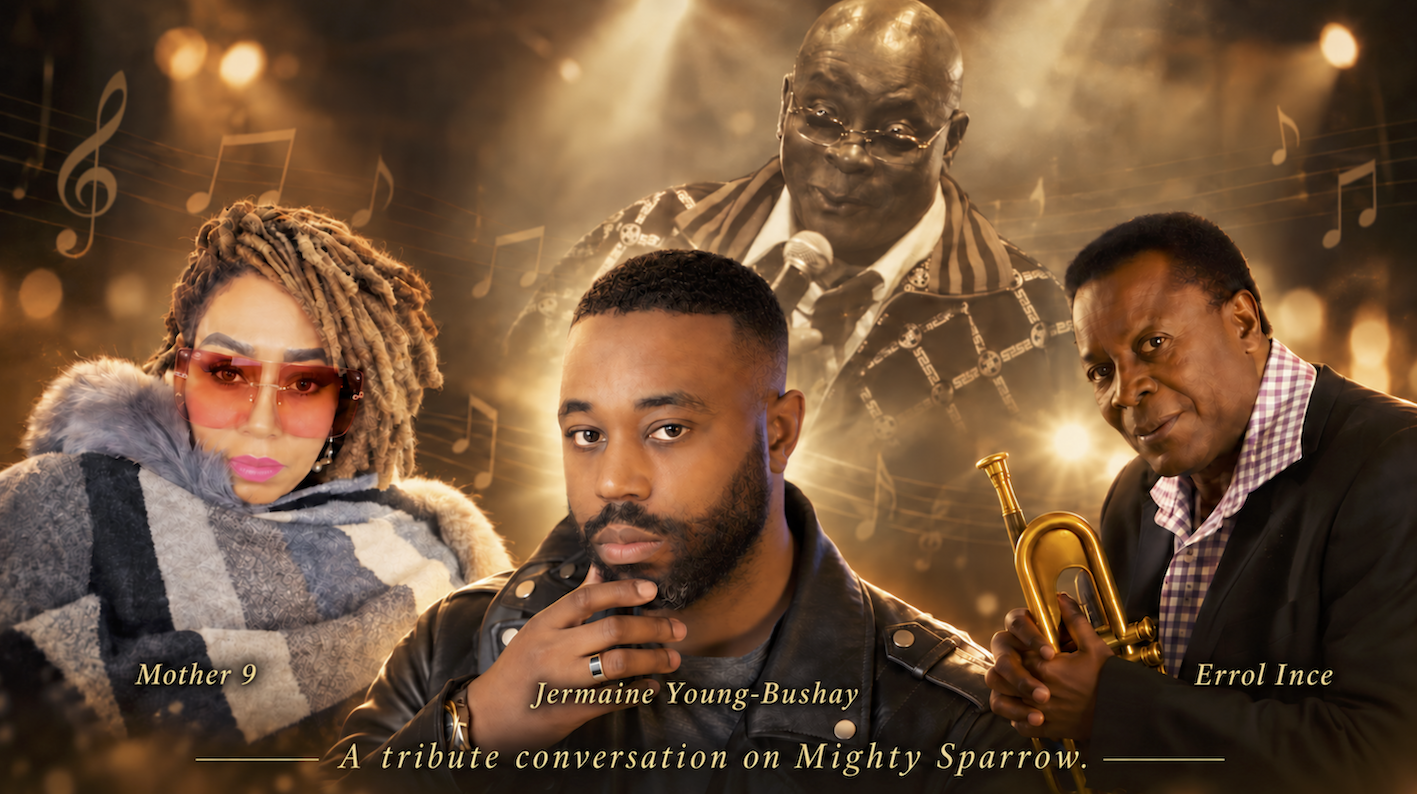
Veteran trumpeter, arranger, composer and musical director Errol Ince speaks to Caribbeans Connects about his extraordinary relationship with the late Mighty Sparrow, his contribution to calypso music, and the musicians behind some of the Caribbean’s most important recordings.
Following the recent passing of legendary calypsonian The Mighty Sparrow, born Slinger Francisco, tributes have continued to come from across the Caribbean and the wider diaspora.
Known around the world as the Calypso King of the World, Mighty Sparrow became one of the most influential performers in Caribbean music, building a career that stretched across generations.
But behind many legendary performers are musicians, arrangers and musical directors whose contribution to the final sound is not always as widely recognised.
One of those musicians is Errol Ince.
In a special Caribbeans Connects interview hosted by Jermaine Young-Bushay, alongside Mother 9, Errol Ince reflected on a personal and professional relationship with Mighty Sparrow that stretched for approximately 70 years.
A Relationship Dating Back to 1955
Ince recalled first working with Sparrow when he was only 16 years old.
He told Caribbeans Connects that he was called to play on an early recording of Sparrow’s famous “Jean and Dinah”, before continuing to work on a large number of Sparrow’s recordings during the late 1950s.
Speaking about their remarkable relationship, Ince said:
“Sparrow and myself, we’ve been back from 1955 to present day — that’s about a 70-year relationship.”
Their connection eventually became much more than music.
“He was like a brother to me, he was like a father to me, he was a very, very good friend to me.”
Ince explained that after spending time in Britain and later establishing himself in the United States, he reconnected professionally with Sparrow and began travelling internationally with him.
He recalled performing and working with Sparrow across five continents and later becoming heavily involved in arranging his music.
From the late 1980s into the 2000s, Ince said he arranged extensively for Sparrow, with the pair maintaining a close working relationship and regularly speaking by telephone.
Errol Ince’s story stretches far beyond his work with Mighty Sparrow.
A highly accomplished trumpeter, arranger, composer and musical director, his career has crossed calypso, soca, jazz and big-band music.
During the interview, Ince recalled travelling to Britain, where he performed with the Ken Mackintosh Orchestra and appeared in the musical environment surrounding BBC’s Come Dancing.
He also served as a bandsman with the 1st Battalion, Royal Fusiliers before returning to Trinidad.
After later moving to the United States, Ince described receiving an opportunity to perform with musicians connected to the Tommy Dorsey Orchestra, before also spending time with the legendary Lionel Hampton.
His musical ambitions were never limited to one genre.
Ince wanted to develop as a serious trumpet player while bringing that musical knowledge back into Caribbean music.
One of the most important moments in the Caribbeans Connects interview came when Ince discussed the lack of recognition historically given to Caribbean arrangers.
He compared the situation with American music, where the name of a major producer or arranger can become almost as well known as the performer.
Ince explained:
“In America, when you talk about Michael Jackson, you talk about Quincy Jones. In Trinidad, when you talk about Mighty Sparrow, Stalin, Kitchener, that’s where it stops. The arranger does not come into it.”
He continued by explaining the importance of musicianship in transforming lyrics and melody into a completed recording.
For Ince, an arranger is not simply somebody working in the background. The arranger helps build the musical foundation that allows the singer and song to work.
During the conversation, Ince also spoke about his trumpet work on calypso recordings and what he believes were important innovations in the use of trumpet solos and sustained trumpet lines within the genre.
When Jermaine Young-Bushay asked about the working relationship between Ince and Sparrow, Ince described Sparrow as a very hands-on artist.
Sparrow would bring musical ideas and sing parts to Ince, but the arranger then had to build a full musical foundation around those ideas.
Ince admitted that there were occasional disagreements during the creative process.
However, he said Sparrow eventually understood and respected the musical decisions being made, allowing the pair to develop a successful working relationship.
That combination of two strong musical personalities helped create a partnership that continued for decades.
Errol Ince’s musical contribution also includes songwriting.
During the interview, he discussed writing “Sweet Soca Man”, famously performed by Baron.
He also spoke about his work with Natasha Wilson, including “Sweet T&T”, and revealed that he eventually worked on 17 songs for the young singer.
These songs have become part of the wider musical history of Trinidad and Tobago and demonstrate the breadth of Ince’s work outside his association with Sparrow.
Caribbeans Connects would also like to clarify an important piece of information concerning Errol Ince’s biography.
Some previously published information about the veteran musician has listed a different date of birth.
Errol Ince’s correct date of birth is 18 April 1939.
This correction is important when documenting the history and career of one of the Caribbean’s significant musicians, arrangers and trumpeters.
Caribbeans Connects would also like to clarify another important point concerning Errol Ince and the song “Oh My Papa.”
Errol Ince did not compose “Oh My Papa.”
His connection with the song comes through his acclaimed solo trumpet rendition and mastery of the piece, rather than through composing it.
This distinction is important to Ince and should be correctly reflected when discussing his musical career.
The song also holds a special place in his personal history.
During the interview, Mother 9 recalled Errol Ince performing “Oh My Papa” as a trumpet tribute at Lord Kitchener’s funeral.
It is therefore a piece strongly associated with Ince as a performer, but not as its composer.
The connection between Mighty Sparrow and the Ince family extended far beyond recording studios and concert stages.
Mother 9 recalled how close Sparrow became to the family and revealed that he was even the best man at her wedding to Errol Ince.
She also shared memories of travelling with Sparrow and Ince and attending major performances and events.
Those personal stories give another side to Mighty Sparrow.
For the Ince family, he was not simply an international calypso star. He was a close friend who was part of their lives for decades.
Ince also revealed the depth of that friendship when discussing a series of recordings Sparrow made later in his career.
He explained that he worked on around 10 albums without taking an arrangement fee because Sparrow was already paying musicians, studio costs and other expenses.
For Ince, that work was a gift to his friend.
It is another example of a relationship that went far beyond a normal professional arrangement.
The interview also turned to the current state of Caribbean music.
When asked whether something was missing from some modern music, Ince gave a simple answer:
Melodies.
For Ince, memorable Caribbean music needs more than rhythm.
It needs a story.
He pointed to songs from artists including Mighty Sparrow, Baron and others as examples of music that remains memorable because listeners can connect with both the melody and the story being told.
His comments raise an important conversation about preserving the musical foundations that helped calypso and soca travel around the world.
Towards the end of the interview, Jermaine Young-Bushay asked Errol Ince how he wanted people to remember Mighty Sparrow in the years ahead.
His answer was clear:
“He was the ultimate professional performer.”
Ince explained that Sparrow possessed the rare ability to control an audience even without singing.
Through humour, storytelling, personality and stage presence, Sparrow could keep a crowd entertained for an entire performance.
For somebody who spent decades beside him in recording studios, on stages and while travelling internationally, that description carries particular weight.
Mighty Sparrow will be remembered through his enormous catalogue of music, his social commentary, humour, storytelling and contribution to Caribbean culture.
But the Caribbeans Connects interview with Errol Ince also highlights another important part of that history — the musicians and arrangers who stood alongside the great artists and helped create the sound.
For Errol Ince, the story of Mighty Sparrow is not simply the story of a musical legend.
It is the story of a friendship that began in the 1950s and lasted approximately seven decades.
It is a story of recording sessions, arrangements, world travel, family, disagreements, laughter, performances and Caribbean musical history.
And it is a story worth preserving.
Watch Errol Ince Remembering Mighty Sparrow, featuring Mother 9 and hosted by Caribbeans Connects founder Jermaine Young-Bushay:
YouTube:
https://youtu.be/bIQTxVFLvZs?si=BHVy-kVYVZXwzJWM
Caribbeans Connects — documenting Caribbean people, music, history and culture across the diaspora.